
This Is *Not* a Talk About AI (It's About Fire, Anthropology, Technology and Humanity)
Thursday, October 1, 2026, 5:00 PM PDT – 7:00 PM PDT
Kiln · 1120 SE Madison St, Portland, OR 97214, USA
Hosted by Ali Maaxa
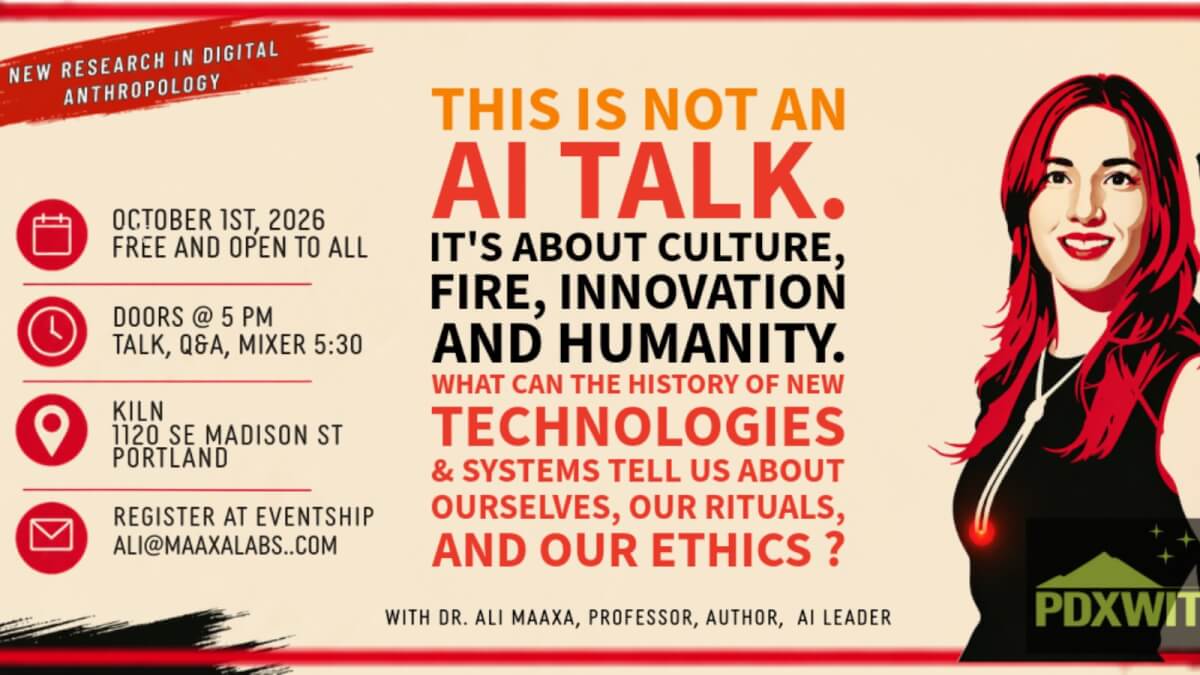
When AI begins to feel uncanny, dangerous, or too powerful to contain, our cultural imagination reaches quickly for Frankenstein. The comparison is everywhere in the current news cycle: a creation escapes its maker, technology accelerates beyond human control, and the world discovers too late that it has built something it cannot govern. The fear is not foolish. AI is moving rapidly into the systems that shape work, education, media, public services, and democratic life. But Frankenstein offers a more interesting warning than the one we usually tell. Mary Shelley’s 1818 novel was shaped by fascination with galvanism, the early electrical experiments that made dead muscle appear to twitch. Its central horror is not simply that Victor Frankenstein creates something powerful. It is that he creates it and then abandons responsibility for what follows. In This Is Not a Talk About AI, digital anthropologist Ali Maaxa, Ph.D. asks what changes when we stop treating AI as an alien force with a destiny of its own and start recognizing it as a human-built infrastructure. A system does not simply “take over.” It receives power through human decisions: whose data it uses, who funds it, what it is allowed to access, which institutions treat its outputs as legitimate, whose labor maintains it, and whether people can challenge its decisions. The story begins long before AI. Neanderthals made birch-bark tar with controlled fire to bind stone tools to handles and hunting shafts. The Gutenberg Bible made authoritative texts reproducible at unprecedented scale and turned interpretation into a public struggle. Electricity extended the human day and television reorganized public attention. The internet promised open connection before becoming an infrastructure of platforms, surveillance, ranking, and concentrated control. Each technology changed not only what people could do, but what became normal. Each produced new anxieties, new gatekeepers, new forms of dependence, and new struggles over who should set the rules. AI belongs in that longer history. It is not “just like” fire, print, or electricity. It is faster, more networked, more opaque, and increasingly able to generate language, classify people, and act through connected systems. It also has a body: chips, data centers, electricity, water, land, extraction, invisible labor, public subsidies, and communities asked to absorb costs that rarely appear in a product demo. For more than 20 years, Dr. Maaxa has studied how people around the world encounter, repurpose, resist, innovate with, and make meaning around emerging technologies. As a researcher funded by Mellon, Peacock, REACH, Wilgus, and NEH, an author of books and articles, and a professor at UNC, Duke, William & Mary, Virigina Tech, PSU & Pierce, she has produced leading work on global digital cultures. A leader in AI innovation and incubation, she has spent the past decade working across New Relic AI, AWS AI, Meta AI, startups, and accelerators, bringing new technologies into public and professional life while advocating for responsible, accessible, deeply ethical use. This is neither an AI sales pitch nor an apocalypse sermon. It is a lively intervention into an overblown public conversation. Maaxa explores the philosophy and anthropology of thinkers like Manuel Delanda (assemblage theory), Stuart Hall (culture, media, and discourse), Donna Haraway (cyborg anthropology), and Victor Turner (ritual and symbolic anthropology). This talk is explicitly not pro- or anti- AI. It is a "detour through theory" that contributes to our agency and action by cultivating a meaningful discourse for discerning ethics, understanding contexts, building collectives, and taking action. It asks: - What is AI actually doing now? - Which human relationships, forms of labor, judgments, and institutions is it rearranging? - Who gets to build and govern it? - Who pays for its infrastructure? - Who can inspect, interrupt, challenge, or repair what it does? The answer is not to pretend risk has disappeared. It is to recover agency as a shared public practice. A technology is not the same thing as a culture of use; how might we both zoom out to the histories, materiality, and structures that give rise to it, and look inward to how we can harness our own agency, dignity, and sense of connection to others to harness, undo, remake, contain, and/or radically transform it? Learn more, book me for a keynote or interview, or get involved: https://notanai.site Talk Introduction by Kellyn Gorman of PDX Women in Tech Kellyn Gorman is theTechnical Swiss Army Knife at Redgate Software, bringing over 30 years of experience as a data and infrastructure specialist to one of the industry's most versatile technical roles. Her career spans work with technology leaders including Oracle and Microsoft, along with AI-focused projects for both Google and Azure, which gives her a rare, cross-platform view of how data, infrastructure, and AI intersect in the real…